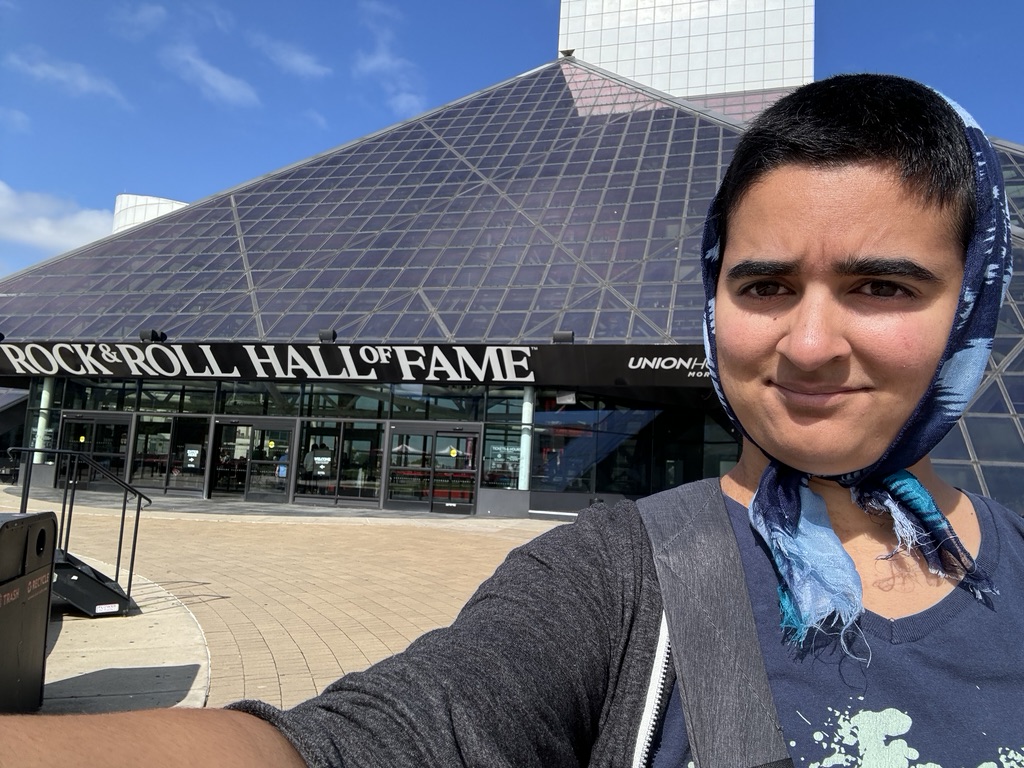
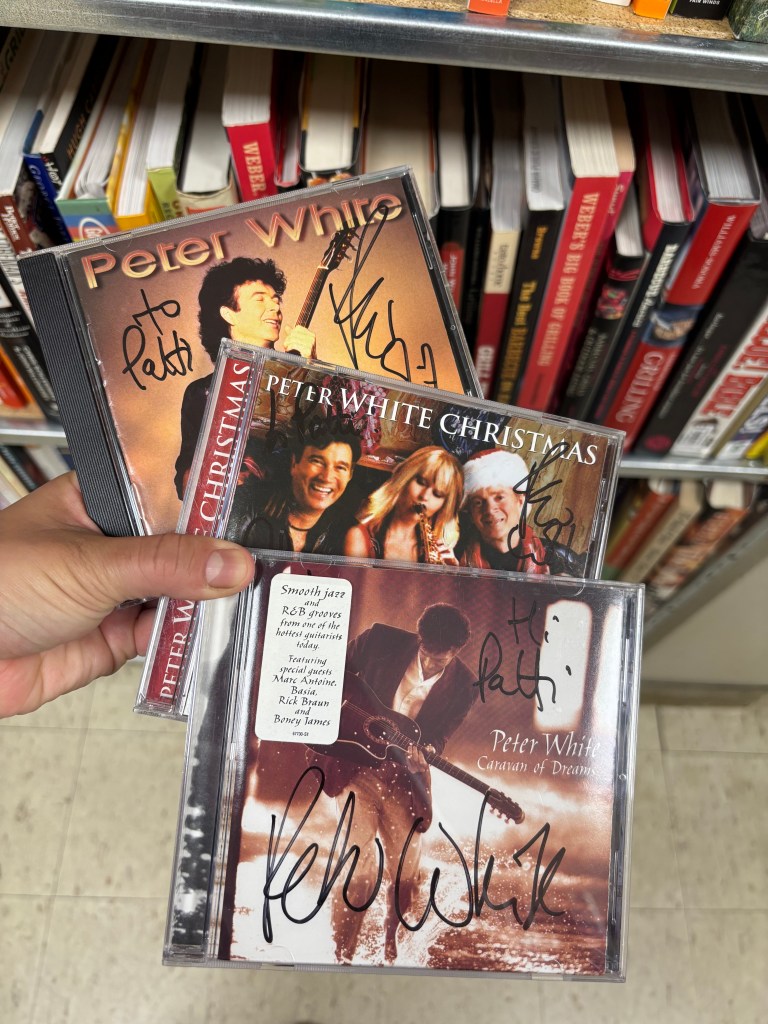
I thought I’d stop by my local library branch for their weekly Friends of the Library blowout media sale. I started with the CDs first, this time, since I was happily surprised with the amount of good discs I found last time. This time I came away with something more surprising than my last visit. I found, not one, but three CDs by Mr. Peter White, who’d been a longtime guitar player in Al Stewart’s band. Not only that, the CDs were all signed, too! I’m not sure who Patti is, but in case you read this, your CDs have found a new home!
This got me thinking of something fun to share in today’s post. I actually interviewed Peter way back in 2020, in the midst of the pandemic. Since lockdown restrictions did not permit us to meet in-person, we opted to conduct the interview over email. I sent the questions and he replied back with his answers. There were 12 thorough answers, so I will post the first 4 in today’s entry. Enjoy!:
An Interview with Peter White – by J Michelle Sample – June 7, 2020:
Part 1. What was your earliest exposure to music? Who were you listening to before discovering The Beatles?
Peter : Ours was a musical family and my father encouraged us to play music rather than listen to recorded music, which he called “canned music”! At around age 5 (1960) I learned to play the recorder along with my sister and older brother and we would play as a trio in talent contests and even around the neighborhood at Christmas time playing door to door. So Christmas music was probably the first music that I learned to play. At the same time I was taking piano lessons – the guitar didn’t come until a few years later. The Beatles hit England in 1962 (I was 7) but because I wasn’t listening to the radio or watching much TV I didn’t take any notice. My dad listened to comedy and classical music on the radio and my mom had some Charles Aznavour records – she was French and he was her favorite French singer. I was quite cut-off from pop music at that time and that was probably deliberate on my parents part! I didn’t become aware of the Beatles until 1963 with the release of “She Loves You”. I remember being in the playground behind our house and some kid was yelling “Yeah, yeah, yeah!” I had no idea what that was until someone told me it was the Beatles, whom I had never heard of. Soon after that my parents bought the EP “Twist and Shout” which I listened to avidly, but honestly before that point I remember mostly playing music, not listening to recorded or “canned music” as my dad put it !
Part 2. Tell me about your first experiences performing with Al Stewart. What were your first impressions of him and how does performing with him differ from performing with other artists?
Peter : I started performing with Al in 1975 and it was the first time I had been on tour so I had nothing to compare it to, but apart from enjoying playing his music I especially liked the way that he talked to the audience, as though he was talking to someone standing right in front of him. I have taken this approach when I do my own shows, and anyway, like Al, I have a fairly quiet speaking voice. I think people like this low-key, conversational approach and it certainly works better in small venues. Also he was hilarious and would make the band laugh just as easily as make the audience laugh! The next time I toured with another artist was with Basia in the early 90s and she related to the audience in a very similar way, speaking in her regular speaking voice while she told stories about the songs. I have seen other artists perform where they hardly speak to the audience and it never seems right – we need to hear a human voice, especially in a mostly instrumental show!
Those early shows with Al in the 70s were so much fun for me as a young twenty something. It was a totally new experience for me having only ever played top 40 music in ballrooms for people on vacation! With Al we were playing original music for people who loved it and I can easily see how musicians turn to drugs and alcohol to retain that high of being on stage. Thinking back to those days, I would sometimes feel lonely after a show wondering about all the people that I had seen in the audience but would never meet. Nowadays whenever possible I take time to meet people after the show – anyone that wants to stop and say hi. That is all part of the show for me and I always enjoy it.
Part 3. You’ve had the privilege of meeting your musical idols over the years. Which experience was the most profound for you? Besides Jimmy Page and Paul McCartney, who else have you met ?
Peter : Meeting both of those guys was profound for me in my early twenties, and very humbling. it made me realize that trying to act cool and wearing fashionable clothing was not going to make me a legend like them, instead it’s a lot of hard work and dedication. I also met Joni Mitchell in a hotel restaurant in the late 70s and she quickly invited me to sit with her and talk. That moment has always stayed with me, for now if someone approaches me in a restaurant to talk I always invite them to sit, remembering how gracious Joni was with me.
Part 4. How does the experience of being an accompanying musician differ from being a permanent member of a band?
Peter : I was only a member of a band twice. The first professional band I was in (Principal Edwards) broke up within a few weeks and the other (Shot in the Dark) broke up after a couple of years. It’s hard to be in a band – everybody has to agree on everything and that hardly ever happens. Like the Beatles, most bands will break up before the members are out of their twenties. When you are in your teens and early twenties, you want nothing more than to be part of a band. As you turn 30, you want to be on your own and make your own decisions – that’s life. Some bands have survived, like the Rolling Stones and Aerosmith but it’s not easy! The first day I met Al he said to me “Bands always break up, but I’m not a band so I’ll never break up!” I thought that was hilarious and I remember thinking that I was going to enjoy being around this guy! Being an accompanying musician is how I’ve been for the most part of my career. It meant I could go off and play with different artists if I wanted and this is what has made my career so interesting and fulfilling.
 The Girl in the Scarf
Leave a comment