Continuing on with the second part of my 12-question interview with Peter White!
Part 5. What goes into the writing and recording process for your music? What software or technology do you use when recording?
Peter : I sing into my iPhone or sometimes I scribble a melody or a bass line on a piece of paper using my own form of music writing. Sometimes a melody will stick in my head for years before I record it (like Flying High from my latest CD). I use Protools in my studio to record ideas but actually most of the work is editing which happens on my laptop at the kitchen table or in an airport (or even on the plane!) I finished my latest CD, Music for Starlux Airlines sitting at my kitchen table at 4 am in the morning! Music isn’t always written melody first. Sometimes it’s just a series of chords played on a piano which is how I wrote “My Prayer” and “Dreamwalk”. Sometimes it’s a rhythm or a bass line as in “Last Days of the Century”. Sometimes a melody comes in a dream, like the opening riff in “Pandora”. Very often ideas come to me on the piano. I really don’t often write music on the guitar which I think people might find surprising. There are exceptions like “Lullaby” and “My Girl Madge” (from my Excusez-Moi CD) which I wrote on guitar in a hotel room in Tokyo. Generally the piano gives me more leeway to incorporate rhythm, bass, chords and melody when I’m coming up with a song. Realistically you have 10 fingers to produce notes on the piano, and only 4 on the guitar neck!
Part 7. You’ve performed many live shows throughout your career, but is there one particular performance that truly resonated with you? In other words, what’s been the best show of your career? Where did this performance take place, and what was special about that show ?
Peter : Really my only way of rating a show is how much fun it was for me. I find it very difficult to rate a show based upon whether I or the band played well or not, as the audience perceives something completely different. I have played shows where I made some bad mistakes and someone came up to me afterwards and told me it was the best show I’ve ever played! The fact that they took the time to stay after a show to tell me this is always quite moving for me. It means that I have found a way to play music that is affecting people’s lives for the better and that has great meaning for me, rather than trying to figure out if I’m a better player than this guy or that guy! The fact of whether I played some mistakes or not is very little perceived by the audience as I have come to learn. As for my most memorable show, I played the Shepherds Bush Empire in London, Nov 1999 and not only was it the biggest show I had ever played in my homeland as a solo artist, it was also the first time I had seen my mum and dad together since they split up in the 70s. It was a very sentimental and memorable performance for me! By the way, there is a term that I and some of my musical friends use which we call “digging yourself” during a show, as in “don’t be digging yourself”. This means if you stop for a moment during a show to congratulate yourself, you have just missed a major cue and lost your place in the show! So we try to avoid that and just focus on keeping the show going. What is coming next? What changes do I have to make in my equipment? Generally musicians don’t rate themselves as players as much as the listeners do. We are always looking at our failings and trying to figure out how to play better and be more effective as performers. That is the only way to improve. As for the show, it’s only good if the audience enjoys it – there is no other measure as I see it. Some people will argue that there is good music and bad music, I say there is only music that you like and music that you don’t like, and that can change as you get older ! I didn’t appreciate Aretha Franklin until the day my brother set fire to our bedroom when I was 14 and burnt my electric guitar to a crisp. She sang “I Say a Little Prayer” and all of a sudden the song and her delivery of it took on great meaning for me. Up till that point it was just another song that went right through me without resonating, but that day I was ready to hear it. Consider also the music of Tchaikovsky, Bach, Handel and Mozart who we are still listening to many years after they have passed, in some cases, centuries. If I ever need a humbling moment I listen to their works and I am reminded that I could never be in that category, which somewhat takes the pressure off, ha ha !
Part 8. Do you consider yourself a jazz player now, even though you came from a rock background ?
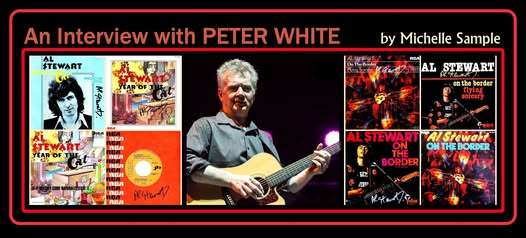
Peter : Jazz music is music largely based on improvisation and although there is some improv in my music, for the most part I am following song melodies with a little improv thrown in here and there. The way I play, the melody of the song far outweighs the improvisation and for this reason I don’t consider myself a jazz musician. It is a question that came up recently on an ASFAB thread and my answer was that when I went to record my first solo album, I made it mostly instrumental as I am not known for my singing voice! Immediately it was categorized as jazz even though I was playing melodies on the guitar that would usually be sung. If I had sung the same melodies it would have been categorized as pop, probably. My playing has not changed that much since I first recorded “On the Border” with Al Stewart in 1975 when I was 20. The songs that I have written over the years however have changed to incorporate more 16th note rhythms, as there is more scope for more interesting rhythms there. As my music does not contain lyrics for the most part, it is definitely an advantage to keep the listeners interested in other ways, and one way to do this is to use 16th note rhythms. These are found mostly in latin music, hip-hop, R&B and yes, jazz! Rock rhythms are mostly based on 8th note patterns and the tempos are generally faster. “Rock and Roll” by Led Zeppelin, for example.
What is music based on 16th notes? Compare Al Stewart’s song, “Soho (Needless to Say)” based on a 16th note rhythm, to Year of the Cat, which is based on an 8th note rhythm. In “Soho” the 16th note rhythm means that Al can get in as many as 16 syllables to each bar – it was one of the first rap songs! Also you hear much more syncopation – he is playing around the beat with the words instead of always on the beat. YOTC is based on a more traditional rock beat and the words come more slowly, as they are following the 8th note rhythm. A possibility of 8 syllables to the bar rather than 16. Also, don’t get fooled that “Soho” is faster than YOTC. Based on beats per minute, the first verse of YOTC is around 115 bpm. The first verse of Soho (original version) is only at around 110 bpm. The 16th note rhythm fools you into thinking that it is faster than it is, and yes I know that the more observant of you will notice that the first 2 words in YOTC “on a” are 16th notes. There will be a prize for that ha ha! However the vast majority of the words in the song fall on 8th notes.


Leave a comment